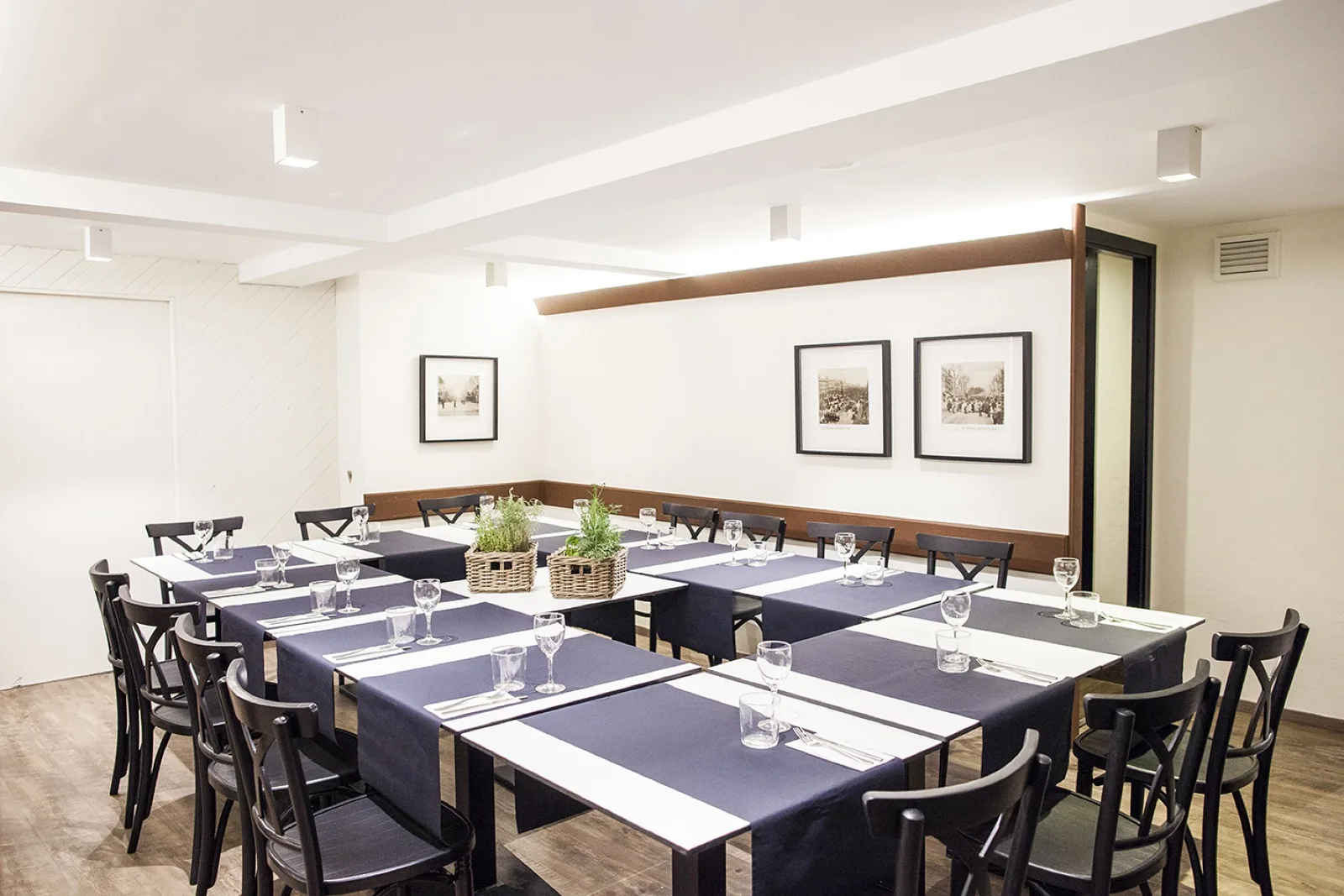
La Castanyada in Barcelona: the night of chestnuts, panellets and the castanyeres
Santa Anna · Carrer de Santa Anna 8, Barcelona · since 1929
Towards the end of October, Barcelona begins to smell of smoke and roasting chestnuts. A brazier appears on a corner, someone feeds it from a sack of chestnuts, and the paper cones start to pile up beside it. By the last night of the month the whole of Catalonia is peeling chestnuts with blackened fingers. This is the Castanyada, the night before All Saints, and it is one of the oldest and quietest festivals in the Catalan year. In 2026 it falls on a Saturday.
We write this from Carrer de Santa Anna, a street in the Gothic Quarter thirty metres from La Rambla, where our family has run a restaurant since 1929. This is what the Castanyada is, where it comes from, who keeps it going on the street, and how to spend the night if you are in the old city.
The night before All Saints
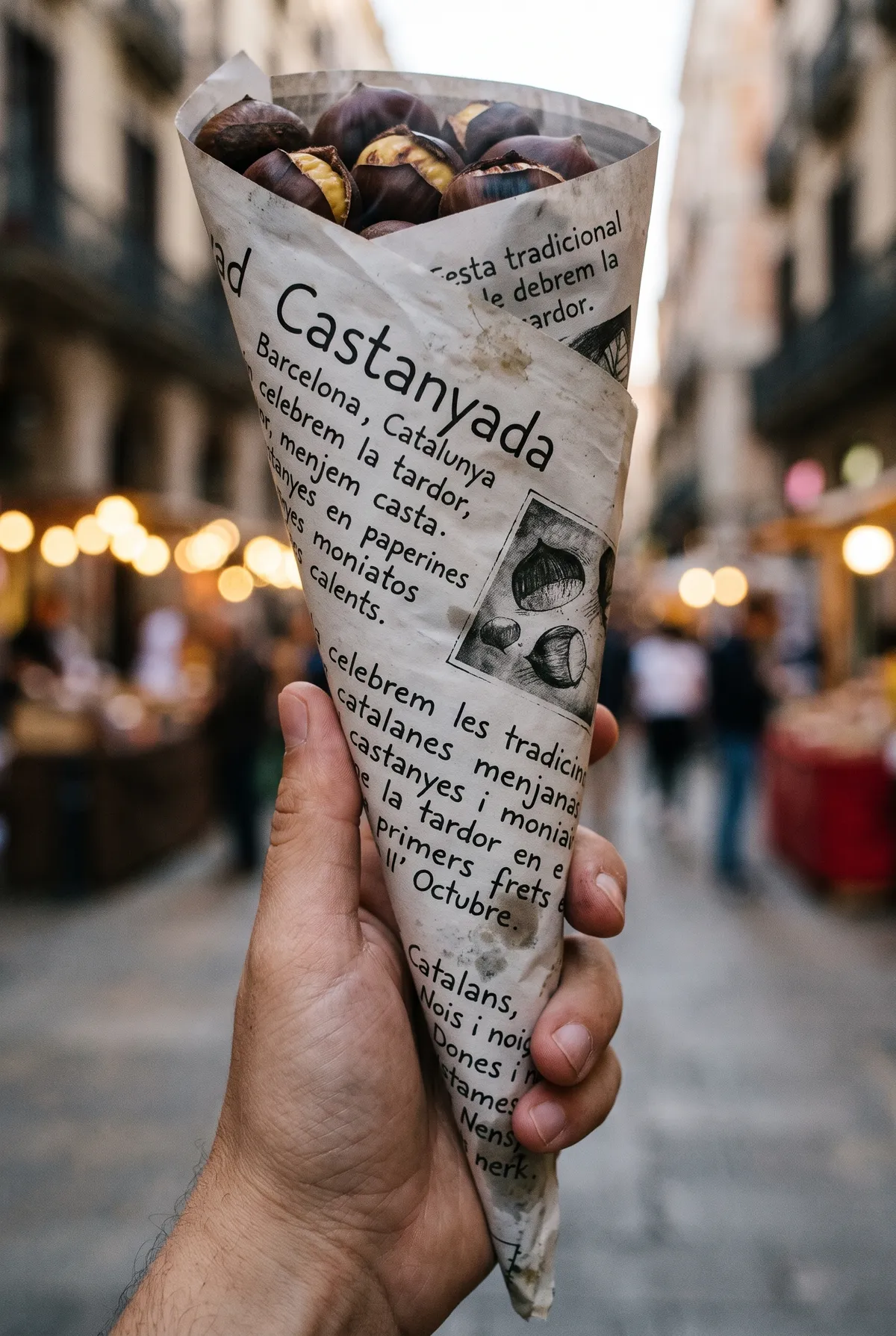
Tots Sants, All Saints’ Day, is the first of November, and in Catalonia it has always been the day families take flowers to the cemetery. The Castanyada is the evening before. Barcelona City Council traces the season back to a Celtic festival of the dead at the turn of November, when the world of the living and the world of the dead were thought to come close enough to touch.
What it became here is something homelier. For centuries families gathered round the fire on the 31st and ate what the autumn gave them: chestnuts, sweet potatoes, a few sweets, a little wine. The story most people tell is about the bell ringers, who spent All Saints’ night tolling for the dead and ate chestnuts to keep going until morning. Nobody can prove it, and nobody needs to. The same night is kept, as Catalan News notes, under other names, in Galicia, where it is the Magosto, in Portugal and in the south of France.
What goes on the table
Castanyes. Chestnuts roasted over coals until the shells split, served in a cone of paper. They are the reason for the night, and they are eaten hot, standing up, a little burnt.
Moniatos. Sweet potatoes cooked in the same embers, dark outside and soft and sweet inside.
Panellets. Small sweets of marzipan, ground almonds and sugar, rolled in pine nuts in their oldest form, and now in coconut, coffee or chocolate too. For many people here the first ones were made at school: in the last week of October, classrooms across Catalonia turn into kitchens, and children carry home a box of lopsided panellets for the family. Pastry shops fill their windows with them for the same week, and the queues go out of the door on the 31st.
Moscatell. A sweet wine from muscat grapes, poured in small glasses to go with the panellets.
The castanyeres
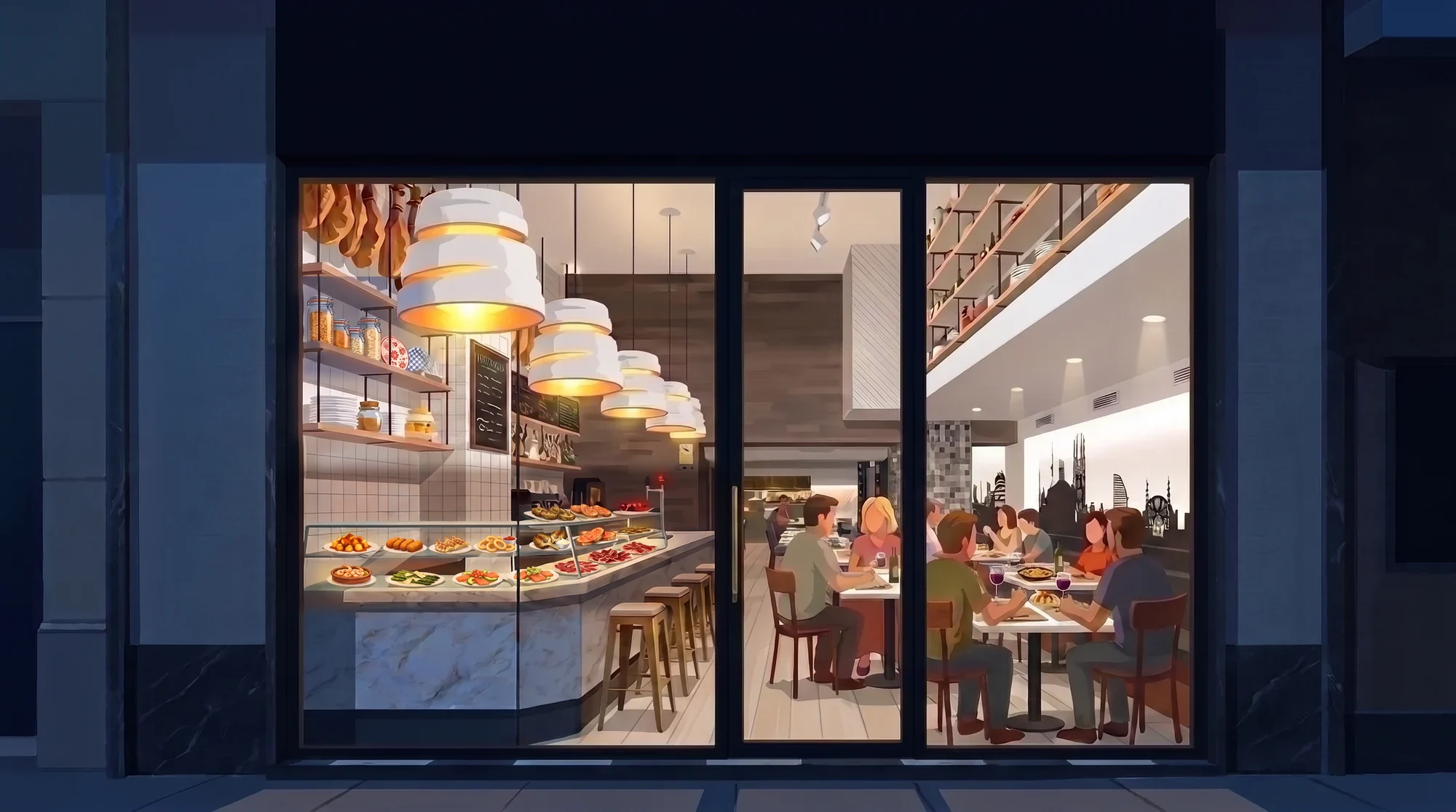
The figure of the festival is the castanyera, the chestnut seller: an older woman wrapped in a shawl and a headscarf, sitting by her brazier on a street corner. Schoolchildren still dress up as her on the 31st. On the real street the headscarf is rarer now, but the stalls are still there, and in Barcelona they are licensed one by one by the City Council, for a season that runs from October to March.
Behind many of them is a family. Sònia Portillo, who runs a stall in the Eixample, is the third generation in hers. Her grandmother came from Ourense, in Galicia, and in 1941 became the first chestnut seller on the Gran Via; the stall still carries the words “Des de 1941” burnt into its wood. Sònia told RTVE Catalunya last November that many of her customers have been coming since they were children, first with their parents and now with children of their own. When Catalan News met Anna, on Ronda de Sant Antoni, in 2020, she had been on the same corner for twenty two years, after two of her uncles had worked it for thirty, and her daughter had a stall of her own on the Gran Via. It is a trade passed from hand to hand, like a recipe.
It is also a harder trade than it looks. Sònia buys her chestnuts in Galicia, and she explained that drought, heat and the fires there have cost the growers chestnut trees two and three hundred years old, the ones that gave the best fruit. A new tree takes about ten years to grow, and its first harvests are poor. Fewer chestnuts means dearer chestnuts, for the stalls and for everyone who buys from them.
Closer to us, the stall by the Santa Caterina market, a few streets from the restaurant, was lit and serving when we walked past at seven in the evening this week, with the smoke drifting down towards the cathedral.
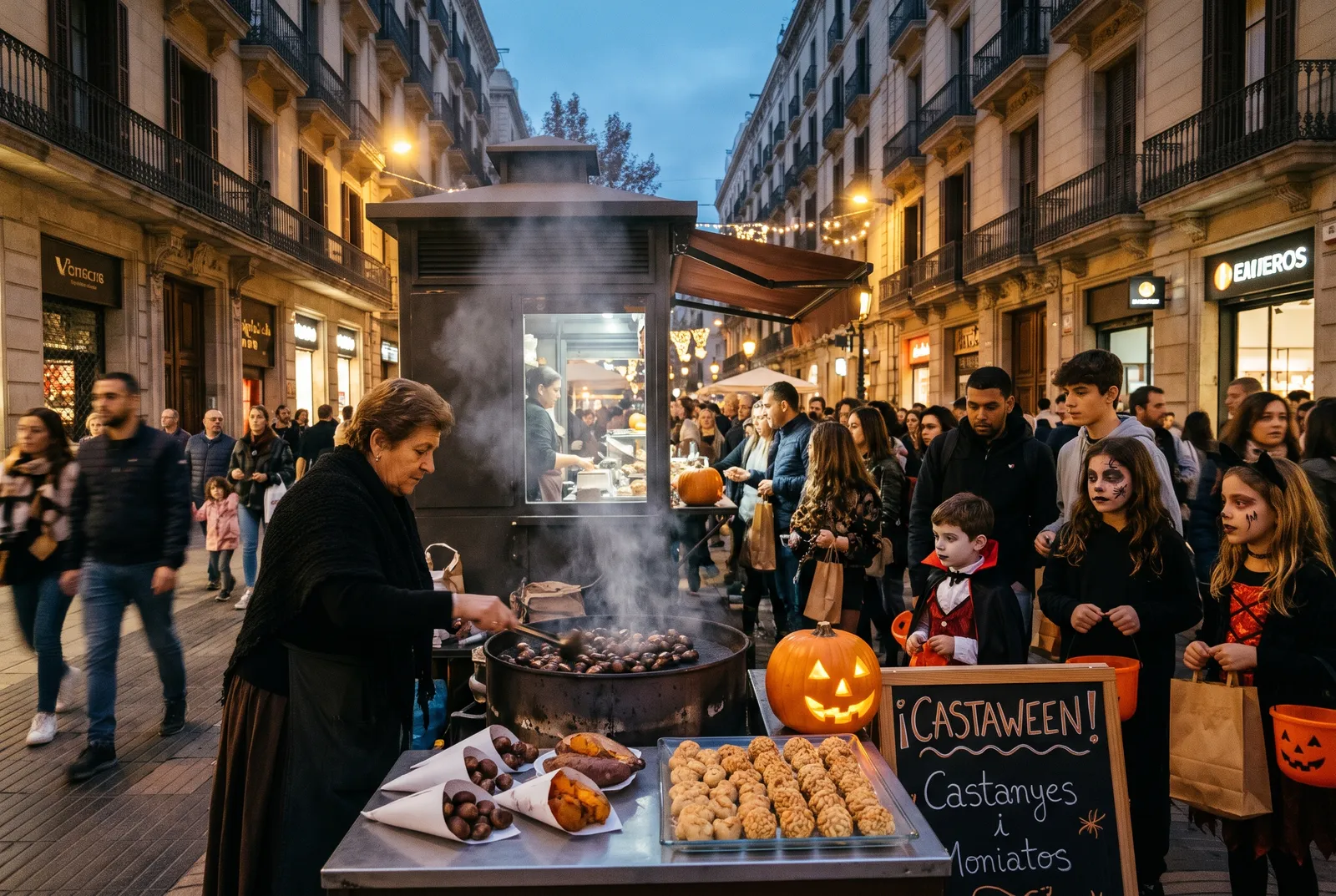
Castaween: when the Castanyada met Halloween
Halloween arrived in Barcelona as a foreign custom, and over a couple of decades it has taken the same night: costume shops, pumpkins in the greengrocers, children going door to door for sweets. Catalans have a word for what happened next. They call it Castaween, the evening when a child dressed as a vampire stands at a chestnut stall with a paper cone in one hand.
Schools show the mix best, as El Món found when it asked around. Some keep strictly to the Castanyada, with a grandmother dressed as the castanyera coming in to tell stories. Others have both: a castanyera and a witch visit on the same day, Halloween lives in the English class, and one school near Barcelona invented a “Castanyera Rockera”, a livelier version of the old seller. Pastry shops have joined in too, with panellets shaped and coloured like pumpkins sitting next to the classic pine nut ones.
The clearest sign of where this is going is outside the city. This autumn Món Sant Benet, the old monastery near Manresa, is running “Operation Castaween” on weekends until 14 November, for families with children between three and ten. The story is built around the Old Chestnut Seller, a castanyera of the monastery woods who cured the sick, roasted chestnuts against evil spirits and made panellets so good they seemed magic. Her recipe book has been cursed, the ingredients have turned into things like troll claws and bat blood, and the children solve clues to break the spell, until at the end they make “terrifying” panellets of their own.
We like it, and not only because it is clever. It takes the most Halloween part of Halloween, the witch and the spell, and hands it to the castanyera; the children go home having made panellets with their own hands, which is exactly what Catalan schools have always done in the last week of October. Halloween supplies the costume; the Castanyada is still what is in the oven. If that is what Castaween means, the old night is in less danger than people think.
Not everyone is pleased. Writers have called the Castanyada the dullest festival in the calendar, Empar Moliner among them, and pointed out that a city of flats has no fireplaces and that late October is often too warm for a brazier. Anthropologists are calmer. Josep Fornés told El Món that cultures have always mixed, and that the Castanyada was never as pure as it seems: the sweet potato came from the Americas, and panellets are said to go back to the sweets of the court of Constantinople. Adrià Pujol has written that the two festivals are simply bound to live together.
The numbers back him. If Halloween were killing the Castanyada, the chestnut stalls would be disappearing, and they are not: Barcelona gave out 28 stall licences in 2015, 36 in 2020, 46 in 2021 and about 65 this year. Schools still make panellets, and pastry shops still sell out. Barcelona did not choose. It kept the pumpkins for the children and the chestnuts for everyone.
If you are in the old city on the 31st
Follow the smoke. The stalls are easy to find in the last days of October, and a cone of hot chestnuts is the simplest way to take part if you are only passing through. Eat them walking, the way everyone does.
Buy panellets on Thursday or Friday rather than on the day itself, when the best ones go first, and if someone offers you a glass of moscatell with them, say yes.
This year the 31st is a Saturday and the next day is a public holiday, so the night runs late. On Saturdays the Barcelona metro does not close, which makes getting home simple. If you stay until Sunday, the afternoon of 1 November brings a Catrina parade for the Mexican Day of the Dead along the Port Vell, finishing at the Columbus monument at the bottom of La Rambla.
And at Santa Anna
Our door is on Carrer de Santa Anna, thirty metres from La Rambla, where the same family has cooked since 1929. On Saturdays we are open from 11:00 until midnight, and the 31st is no different; the kitchen does not close in the afternoon.
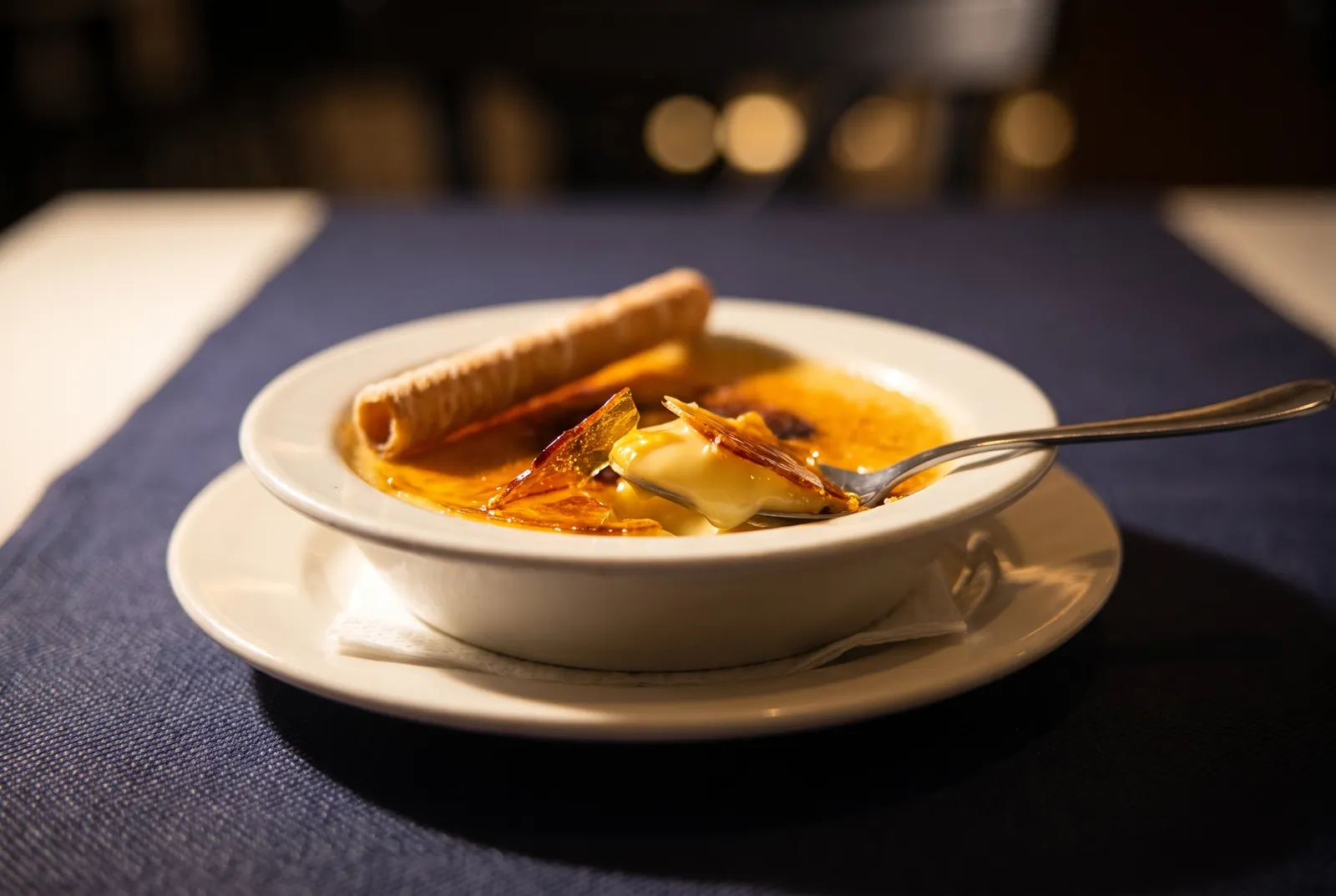
We do not make a special menu for the Castanyada. That night we serve what we serve all year: rice cooked to order, any of the seven for a single person if you like, and for dessert a crema catalana, the Catalan sweet that ends meals all over this city. Afterwards, the chestnut smoke is never far away.
Questions people ask
When is the Castanyada? On 31 October, the eve of All Saints’ Day. In 2026 it falls on a Saturday.
What do people eat at the Castanyada? Roasted chestnuts, roasted sweet potatoes and panellets, small marzipan sweets rolled in pine nuts, with a glass of sweet moscatell.
Who are the castanyeres? The chestnut sellers who set up braziers on Barcelona’s street corners from October. The castanyera, an older woman in a shawl and headscarf, is the traditional figure of the festival.
What is Castaween? The name Catalans give to the night when the Castanyada and Halloween meet. They fall on the same night, but the Castanyada is a Catalan tradition of chestnuts and panellets eaten with family before All Saints’ Day, and Halloween is an imported festival of costumes and scares. Barcelona celebrates both.
Is 1 November a holiday in Barcelona? Yes. All Saints’ Day is a public holiday across Spain. In 2026 it falls on a Sunday.
To book
If you would like a table with us on Saturday the 31st, you can book a table or call us on 933 18 63 36. You can also look at the menu, or read about the Gothic Quarter, the streets around the restaurant.
Carrer de Santa Anna 8, thirty metres from La Rambla. Open every day.
Sun to Thu 11:00 – 23:30Fri and Sat 11:00 – 00:00