How to organise a company Christmas dinner (and get it right first time)
Santa Anna · Carrer de Santa Anna 8, Barcelona · since 1929
If the company Christmas dinner has landed on your desk this year, you’ll probably start with the price. That’s a beginner’s mistake. Anyone who has organised a few of these in HR knows you can compare prices in ten minutes, and that what decides whether the night goes well, or gets remembered as “that dinner”, is everything else: how the food is served, whether the cutlery is changed, whether everyone has a water glass, how long the table is yours and what you agreed to when you paid the deposit.
This is the list someone who has done it many times would give you, written for someone doing it for the first time. We back it with data: on 12 November we read the Christmas and group menus that fourteen Barcelona restaurants publish on their websites or in the PDF they send to companies. We write it from Santa Anna, a family restaurant in the Gothic Quarter since 1929 that also does group menus, so our prices are in the table with everyone else’s. Read them as carefully as anyone’s.
Before you call anyone: three numbers
No restaurant can give you a useful answer without these three, and almost every booking that goes wrong starts with one of them left open.
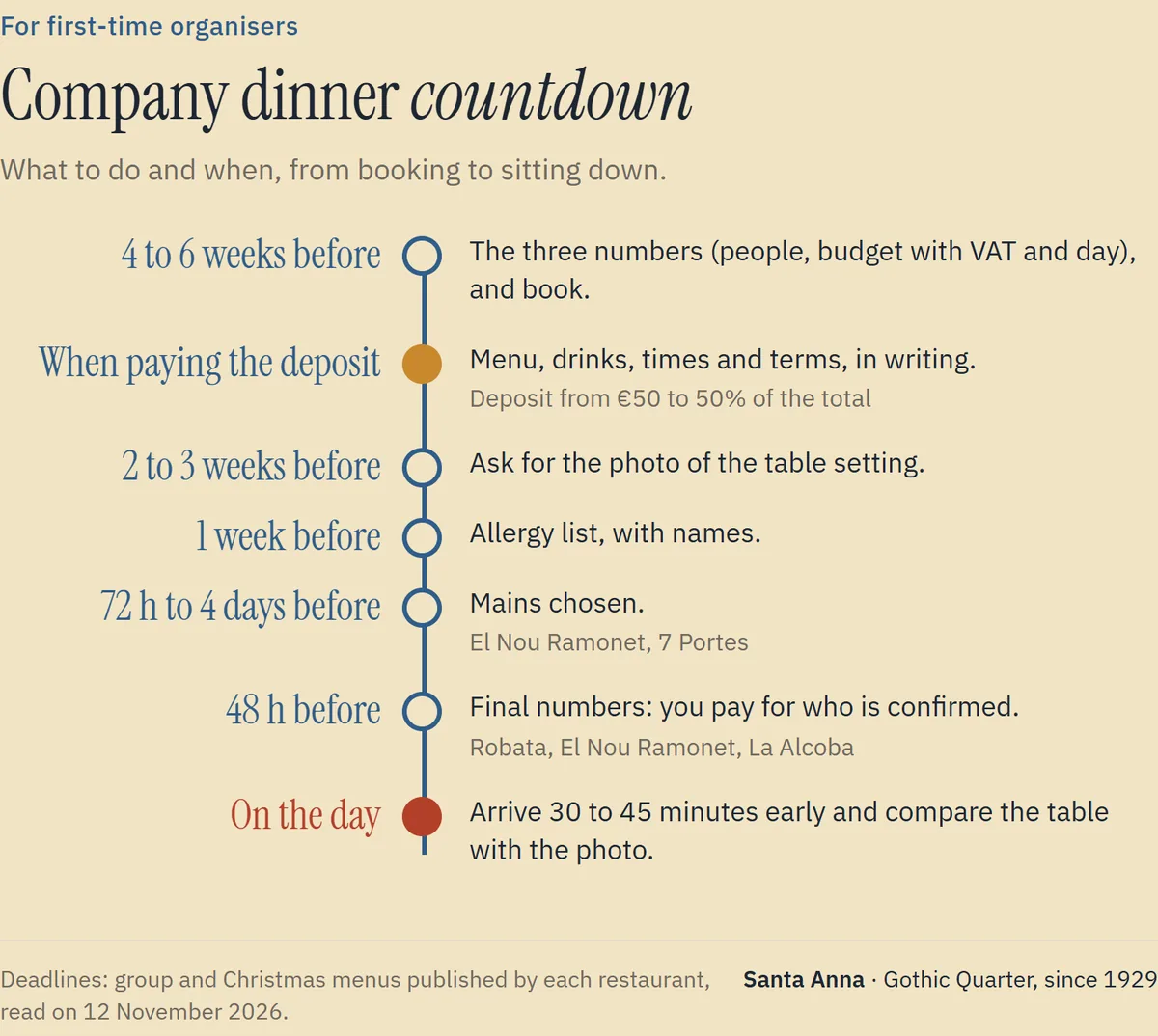
- How many of you, with a margin. Ask the team to confirm before you book, and add 10% for the undecided. You’ll be asked for final numbers 48 hours before, and you’ll pay for that number.
- How much per head, with VAT and drinks. Ask management whether the budget covers wine, coffee and a drink afterwards. “About 50 euros” is not a budget.
- Lunch or dinner, and which day. Lunch isn’t cheaper (more on that at the end), but on a Thursday lunchtime there are more free tables and the floor staff are less stretched than on a Friday night.
Talk about the service before the menu
This is the conversation almost nobody has the first time, and the one that shows most at the table. Before you pay the deposit, ask the restaurant’s group contact to walk you through the night, course by course. If they hesitate or say “the usual”, ask more.
How each course is served
There are three ways, and you should know which one you’re being sold:
- Sharing platters in the middle. Usual for starters. Ask how many platters there are and how many people each one is for: one per four is comfortable; one per eight, on a long table, leaves half the table watching the croquettes run out at the other end.
- Plated, one per person. This is what makes it feel like a “proper” dinner, especially for the main. Ask whether all the mains come out together. With 30 people and three mains to choose from, someone usually eats while others wait unless the kitchen has planned for it.
- Mixed. Shared starters and a plated main. For most groups, the best balance.
Also ask how many floor staff will look after your group and whether they’ll be the same people all night, and how long there is between courses. A good pace leaves room to talk; a bad one leaves you an hour in front of an empty starter plate.
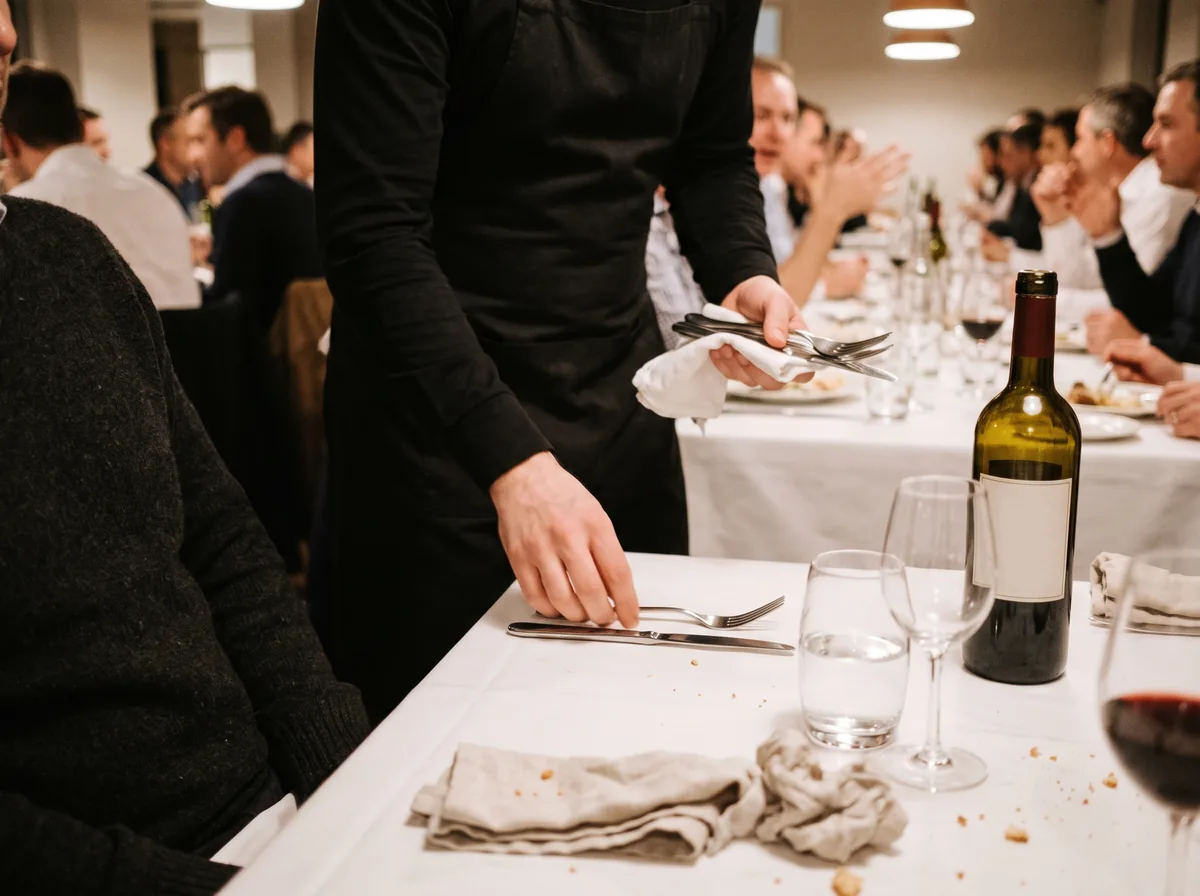
Clean cutlery for every course
Ask, in these words: “Do you change the cutlery between the starters, the main and dessert?” In many restaurants it’s standard, but on some budget group menus you keep the same fork for the croquettes, the fish and the cake. The same goes for plates: the starter plates should be cleared before the main arrives. Nobody mentions it the next day when it’s done well, and everybody does when it isn’t.
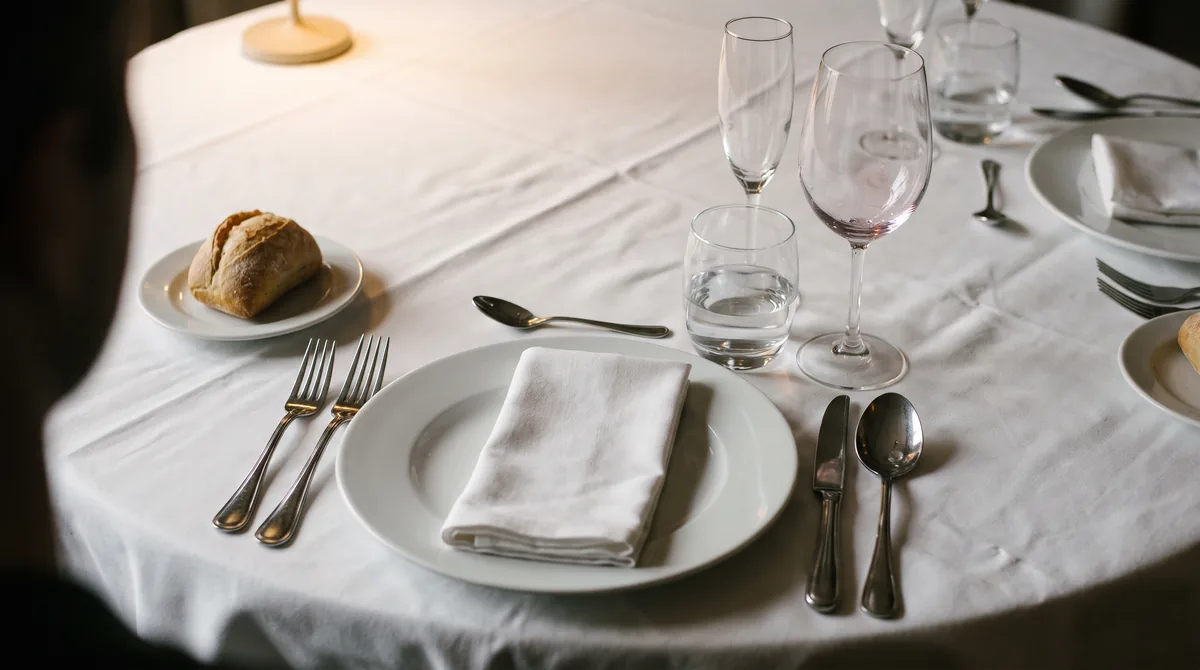
At least two glasses each
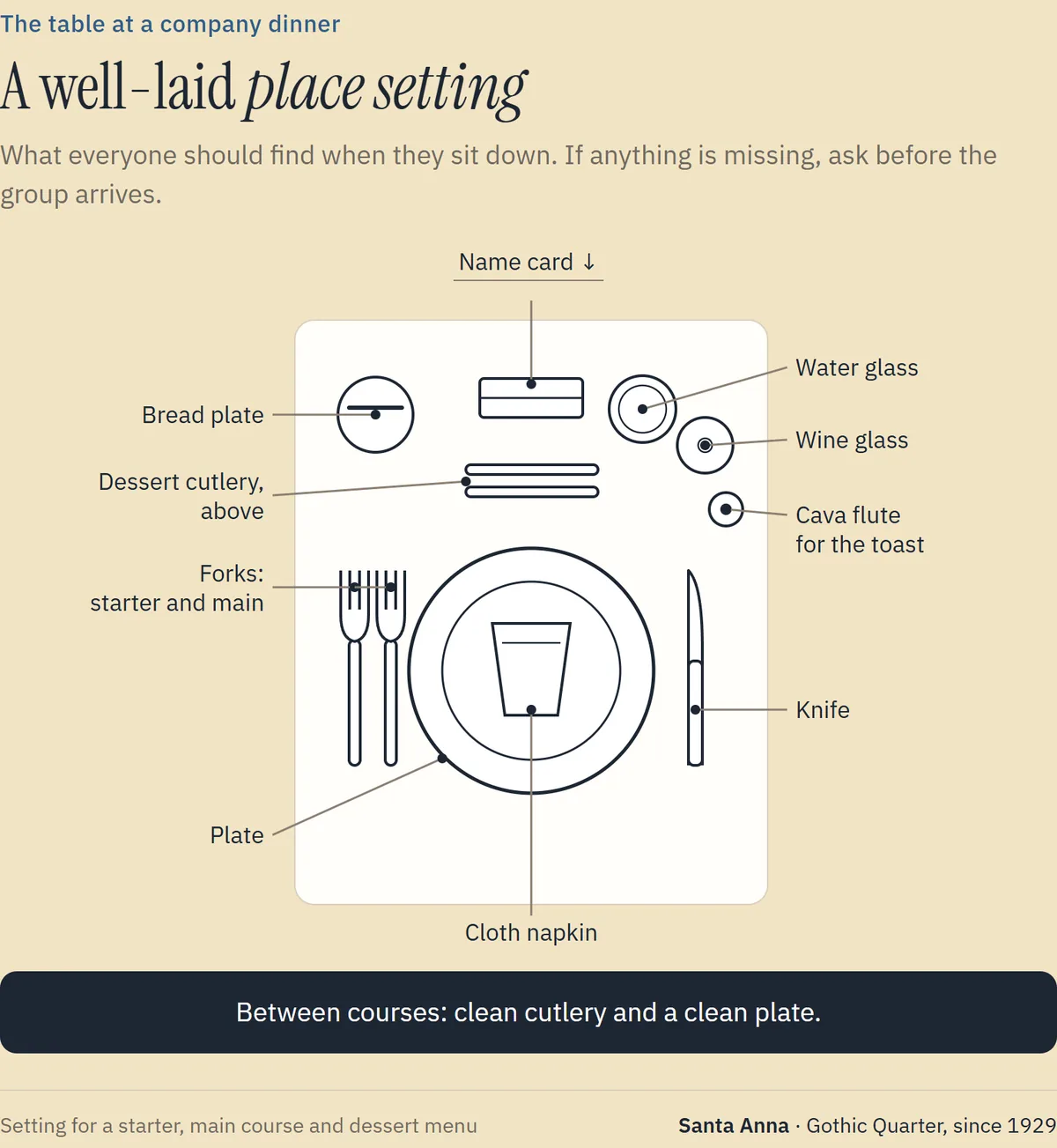
Every place should have a water glass and a wine glass. It sounds obvious, and it isn’t always: some group set-ups give one glass per person, and people end up drinking water from the wine glass or wine from the water glass. If there’s a toast, ask whether there will be a cava glass or whether you toast with whatever’s on the table.
Also ask:
- Who pours. Does someone from the floor serve the wine, or are bottles left on the table?
- Water. Jugs on the table, or bottles charged separately?
- What happens when the menu’s drinks run out. “One bottle per three” is the measure almost everywhere. After that, is the next bottle charged whole or by consumption? At what price? Get it in writing.
- Coffee. It’s included at El Nou Ramonet and 7 Portes; at Dabutis it’s extra. Thirty surprise coffees on the final bill are not something you want to explain to finance.
Ask for a photo of the table setting
This is the tip people are most grateful for the first time: ask for a photo of a table set for a group like yours, not the nice photo on the website. If the restaurant has an event before yours, ask them to take it that day. It should show:
- the tablecloth (cloth or paper) and the napkin,
- how many glasses there are at each place,
- the cutlery laid for the first course,
- how the tables are joined: one long table or several islands.
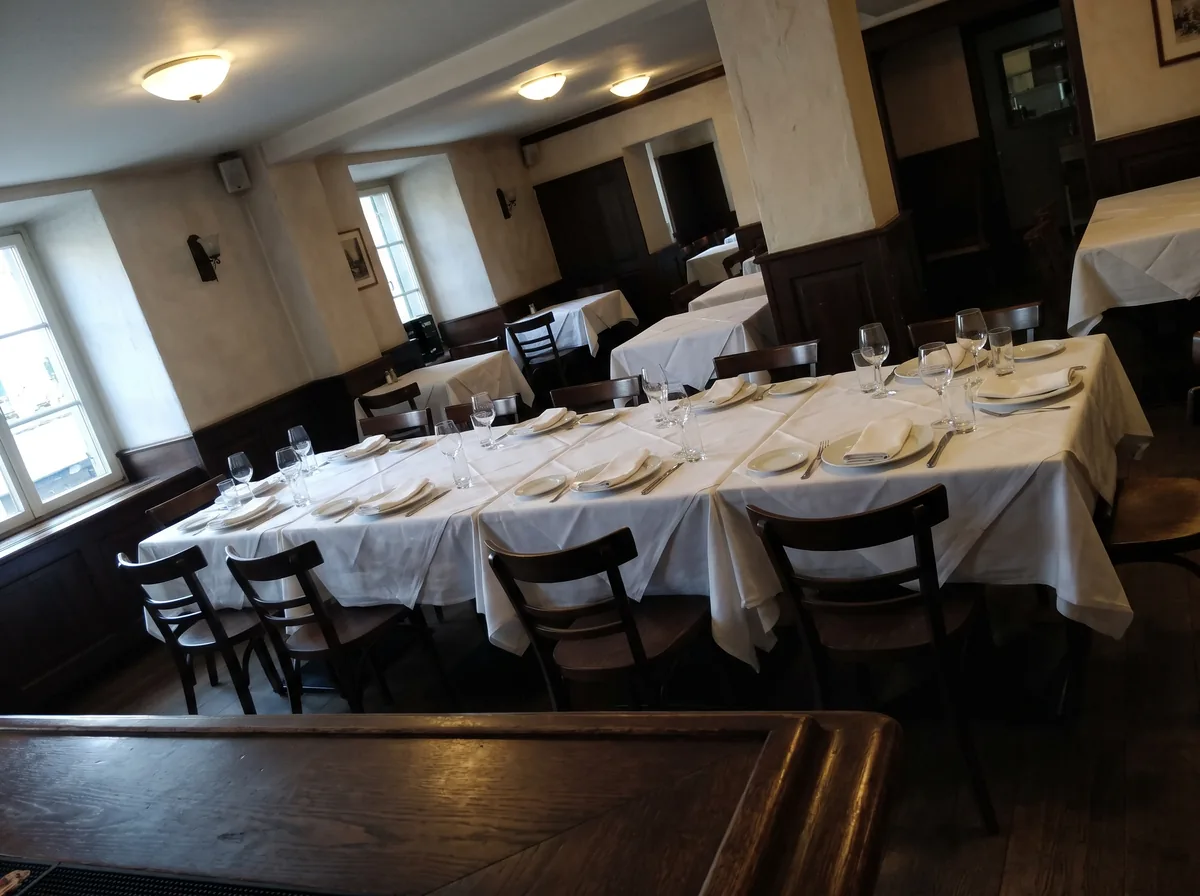
It matters most at the cheaper places. Not because they set tables worse, but because a tight menu is where there’s the most variation from one table to the next. With the photo, you arrive early on the night, compare, and if something’s missing you ask for it calmly before anyone walks in.
How the tables are arranged
Ask whether you can all sit at one long table or will be split across several. A long table brings the team together, but beyond about 25 people one end can’t hear the other. Several tables of eight to ten work better for big groups, as long as they’re together in one area and not scattered among other diners. If management will say a few words, ask where that person can stand to be heard without a microphone.
Allergies and intolerances, in writing and by name
Restaurants in Spain must tell you which of the fourteen allergens are in each dish (Royal Decree 126/2015). Your job is to make sure the information arrives complete: send a list with each person’s name and what they can’t eat at least a week ahead, and confirm it with the final numbers. Ask whether their dish will come out at the same time as everyone else’s. Nobody wants to be the one waiting ten minutes while the rest have started.
How long the table is yours
The lingering after dessert is half of a company dinner. Ask what time you have to leave the table and whether there’s a second sitting after you. Some places limit it by day: Robata only takes groups from Sunday night to Friday lunch, and El Nou Ramonet closes at 5 pm on the 24th and 31st. If you’ll want a drink afterwards, ask whether you can stay at the bar.
What it costs in 2026: about €60 a head
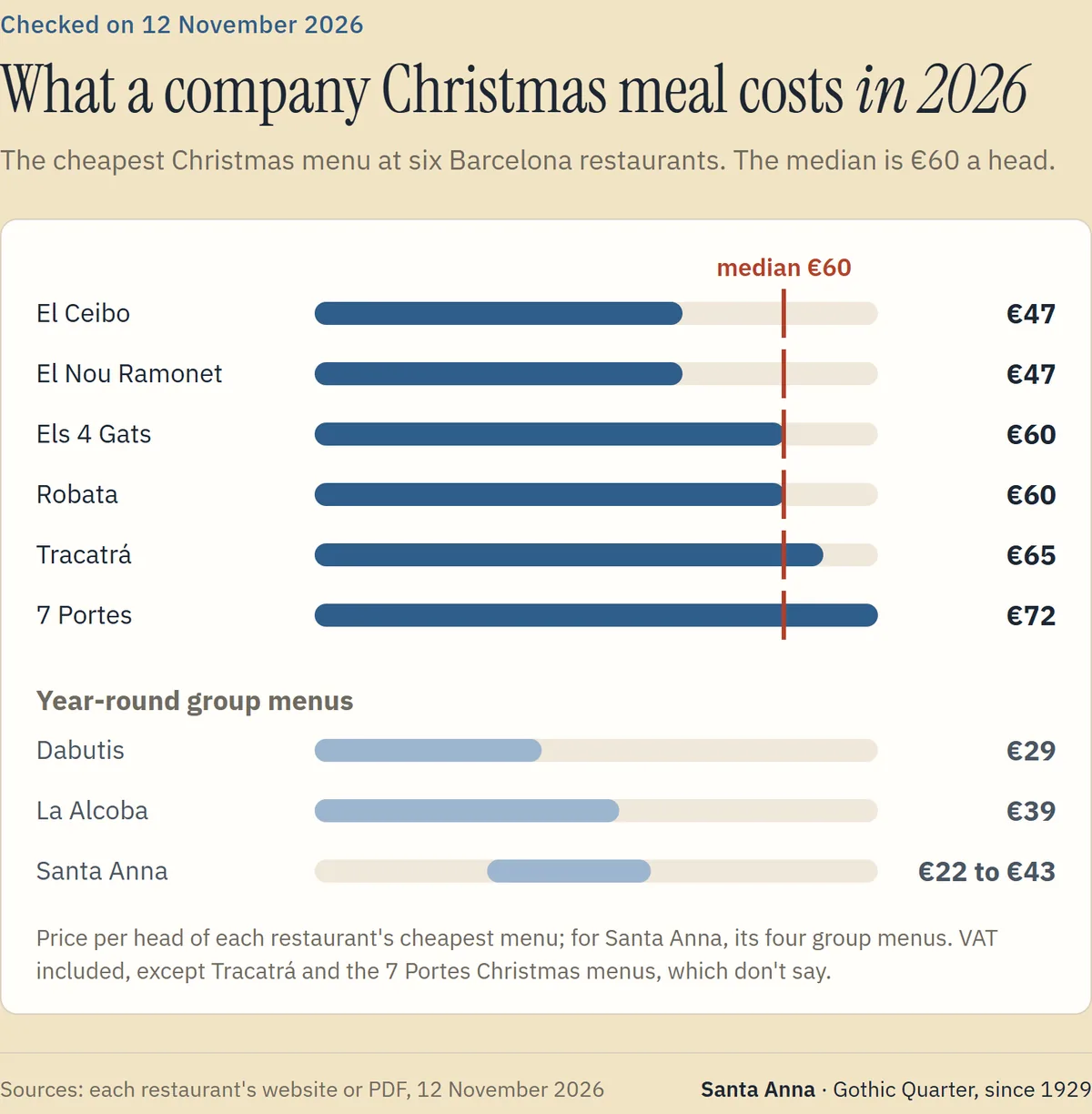
Six of the fourteen restaurants we read publish a company Christmas menu for 2026. The cheapest at each costs €47 at El Ceibo and El Nou Ramonet, €60 at Els 4 Gats and Robata, €65 at Tracatrá and €72 at 7 Portes. The median is €60 a head, and the fullest menus at the same places reach €80, €92 and €120. Below them are the year-round group menus that many companies book in December anyway: €22 to €68.
| Restaurant | Menus per head | Drinks | Group | Deposit |
|---|---|---|---|---|
| El Ceibo, Eixample | €47, €57 | open bar with the €57 menu | 25 to 60, whole venue | €200 |
| El Nou Ramonet, Barceloneta | €47 to €66 | 1 bottle per 3, coffee | from 8, private rooms | 30% |
| Robata, Eixample | €60, €70, €80 | 1 bottle per 2 | 11 to 18 | 50% |
| Tracatrá, Sant Pere | €65 | half a bottle each, cava | tailored | 50% |
| 7 Portes, Port Vell | €72, €92, €120 | 1 bottle per 3, coffee | up to 39, private rooms | yes, amount not published |
| Maná 75, Barceloneta | €68 (Manavilla menu) | 2 drinks each, water and coffee | not stated | not stated |
| La Alcoba, Gothic Quarter and Call | €39, €45, €50 (group) | 1 bottle per 3 | up to 40 | not stated |
| Dabutis, Horta | €29, €35 (group) | 1 drink or 1 bottle per 3, no coffee | room for 20 | €50 |
| Santa Anna, Gothic Quarter | €22, €25, €32, €43 (group) | water and wine or sangria, 1 per 3 | long table | ask us |
Prices include VAT, except Tracatrá and the 7 Portes Christmas menus, which don’t say. Checked on 12 November 2026 on each restaurant’s website or PDF; Maná 75 on 16 November, on the page for its Manavilla menu, which it also sells as a gift voucher. We left out menus that only apply on 25 and 26 December, which are a different thing.
Now you know which bracket you’re in. Before you book, read carefully what you’re signing.
What you sign when you pay the deposit
Before you pay, have in writing the menu, the price with VAT, the drinks included and these three conditions:
The deposit. It ranges from a flat €50 to half the bill: €50 at Dabutis, €200 at El Ceibo, 30% at El Nou Ramonet and 50% at Robata and Tracatrá. Twenty people at €60 is €1,200, and with a 50% deposit you pay €600 before anyone sits down. Ask what happens to it if you cancel: at 7 Portes it’s lost if you cancel less than four days ahead.
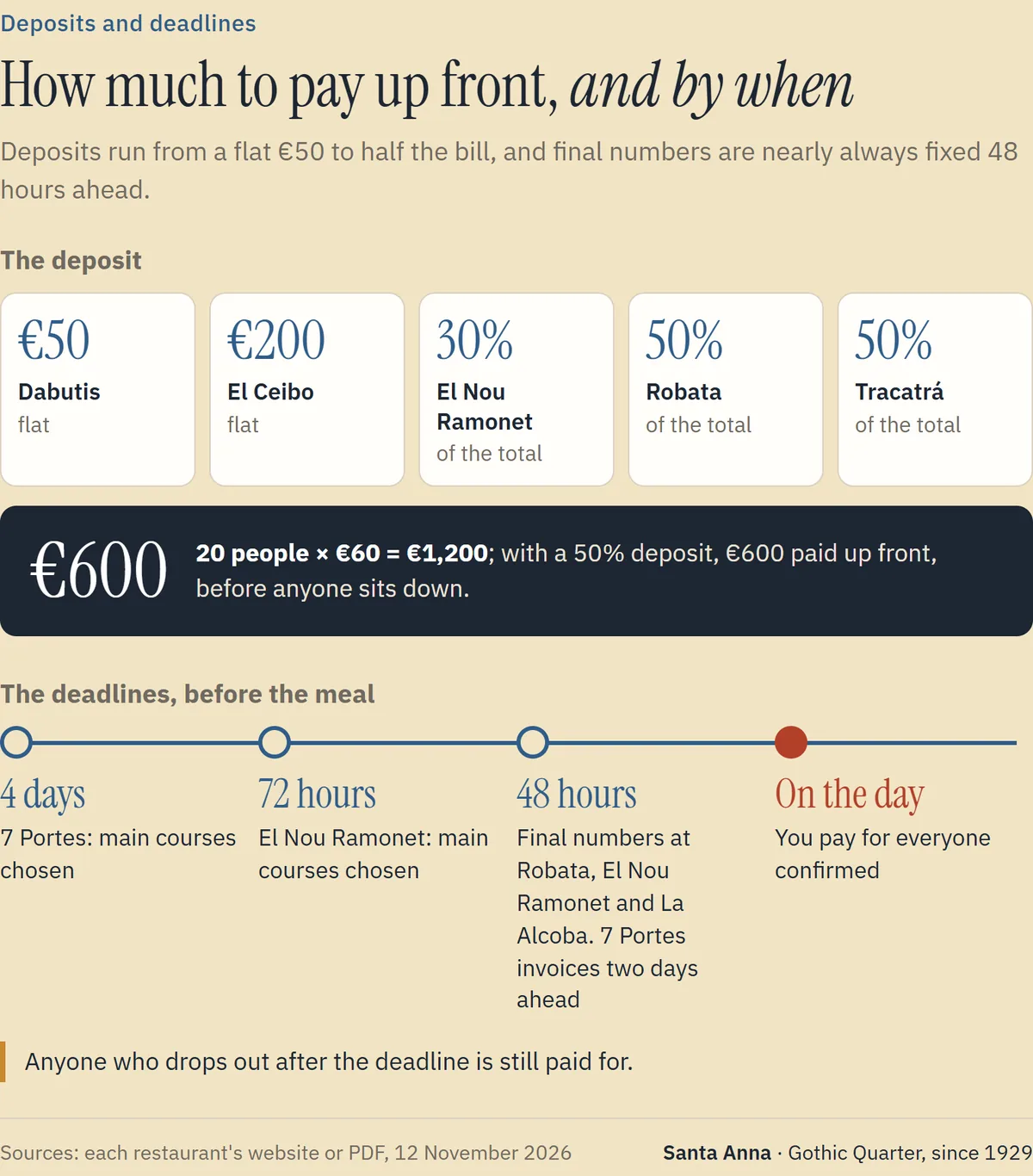
Final numbers. The real deadline is 48 hours, not a week. Robata, El Nou Ramonet and La Alcoba close numbers 48 hours before, and 7 Portes bills the menus confirmed two days before. Mains are chosen even earlier: 72 hours ahead at El Nou Ramonet and four days at 7 Portes. Anyone who drops out after that is paid for.
The invoice. Ask for an invoice in the company’s name, with its tax number (CIF), and ask how the rest is paid: company card, transfer beforehand or on the night. How the dinner is accounted for is your accountant’s call, but you have to ask for the invoice details.
How to make a budget menu feel a class above
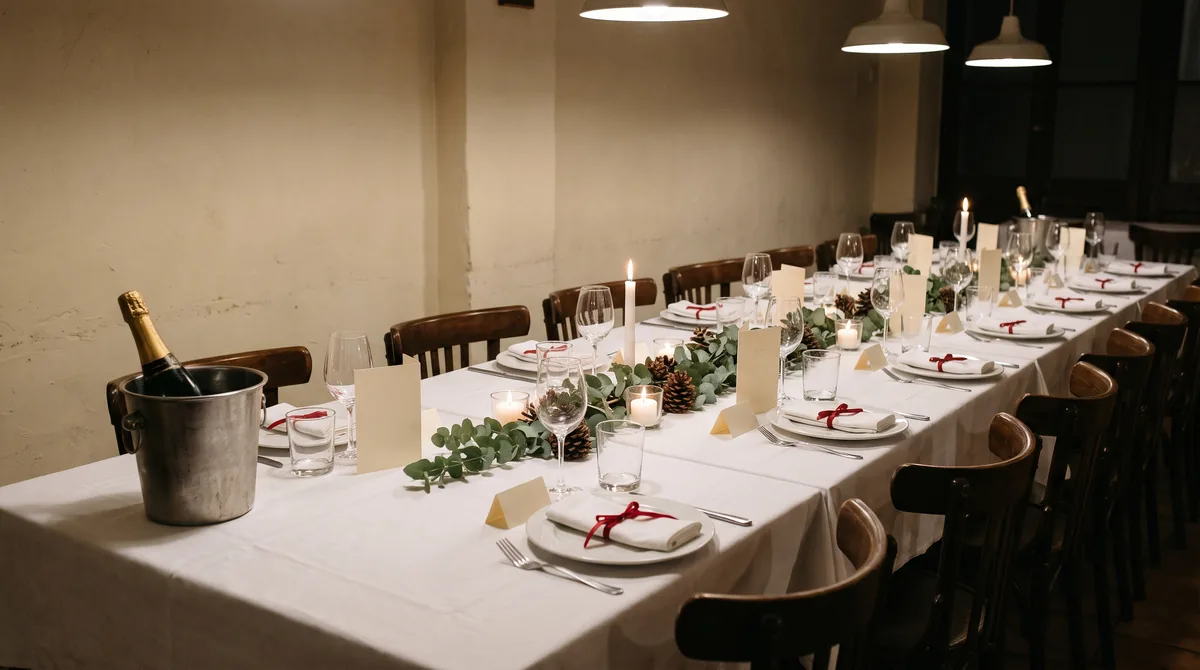
You don’t need the €92 menu for the dinner to feel looked after. What people remember is how the table looked, whether they felt well served and whether there was a moment to raise a glass. Most of that is asked for, not paid for. In order of how much it shows:
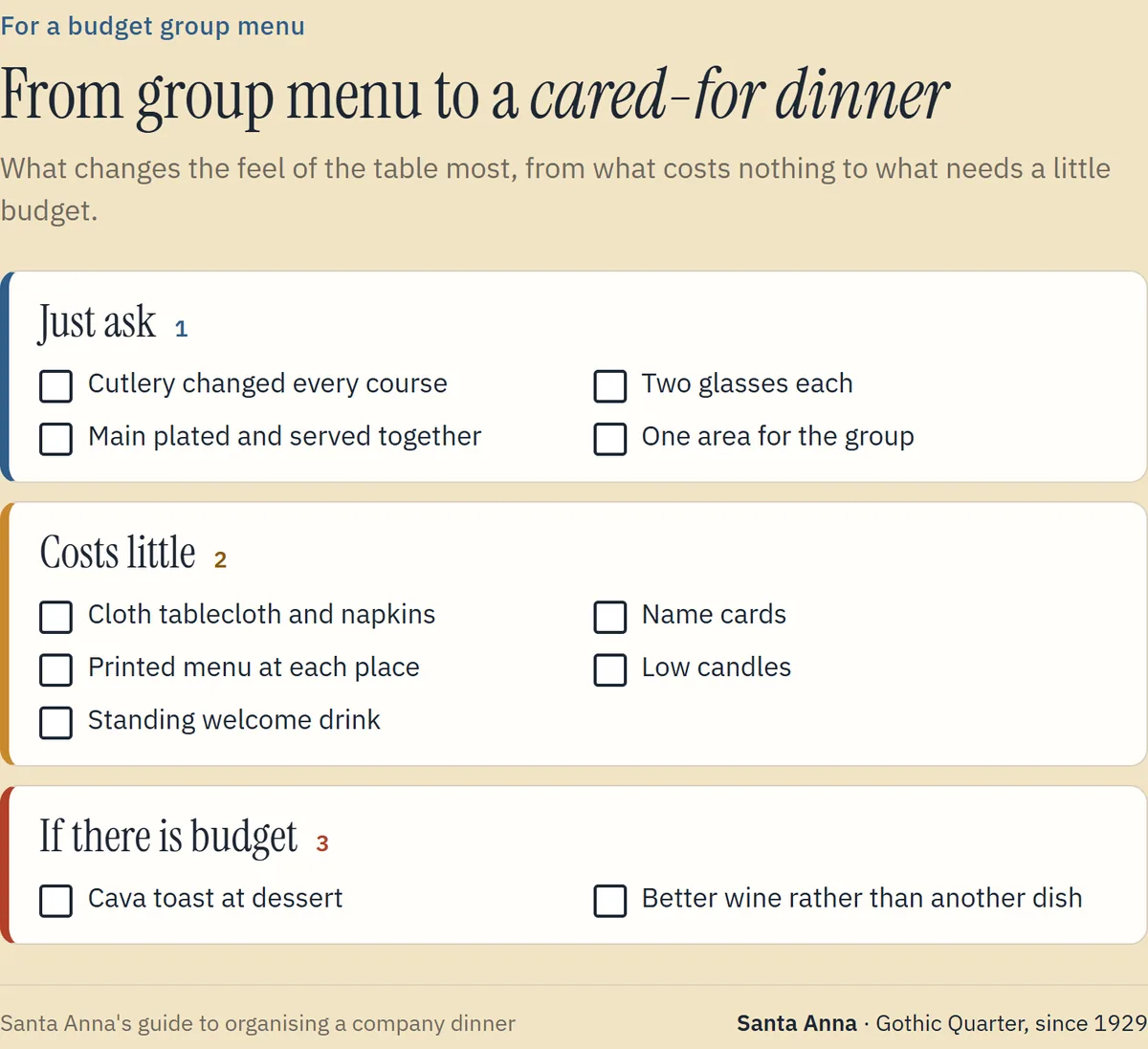
- Clean cutlery and plates for every course, and two glasses each. Everything above. It’s the first thing that separates a group meal from a cared-for dinner, and in many places you only have to ask.
- Cloth tablecloth and napkins. If the group menu comes with paper, ask whether it can be changed and what it costs. Few things change a photo of the table so much.
- A plated main. Even if starters are shared, a main served to each person, all at once, lifts the whole dinner.
- One table, not several scattered ones. Better one area for the group than more space spread among other diners.
- Name cards. Cheap to print, and they solve the most awkward moment of the night: who sits where. Use them to mix departments.
- A printed menu at each place. A card with the night’s dishes, with the company logo if you like. Ask the restaurant first and get the exact names of the dishes.
- Low candles or a simple centrepiece. Ask whether you can bring them. Always low: a tall centrepiece stops you talking to the person opposite.
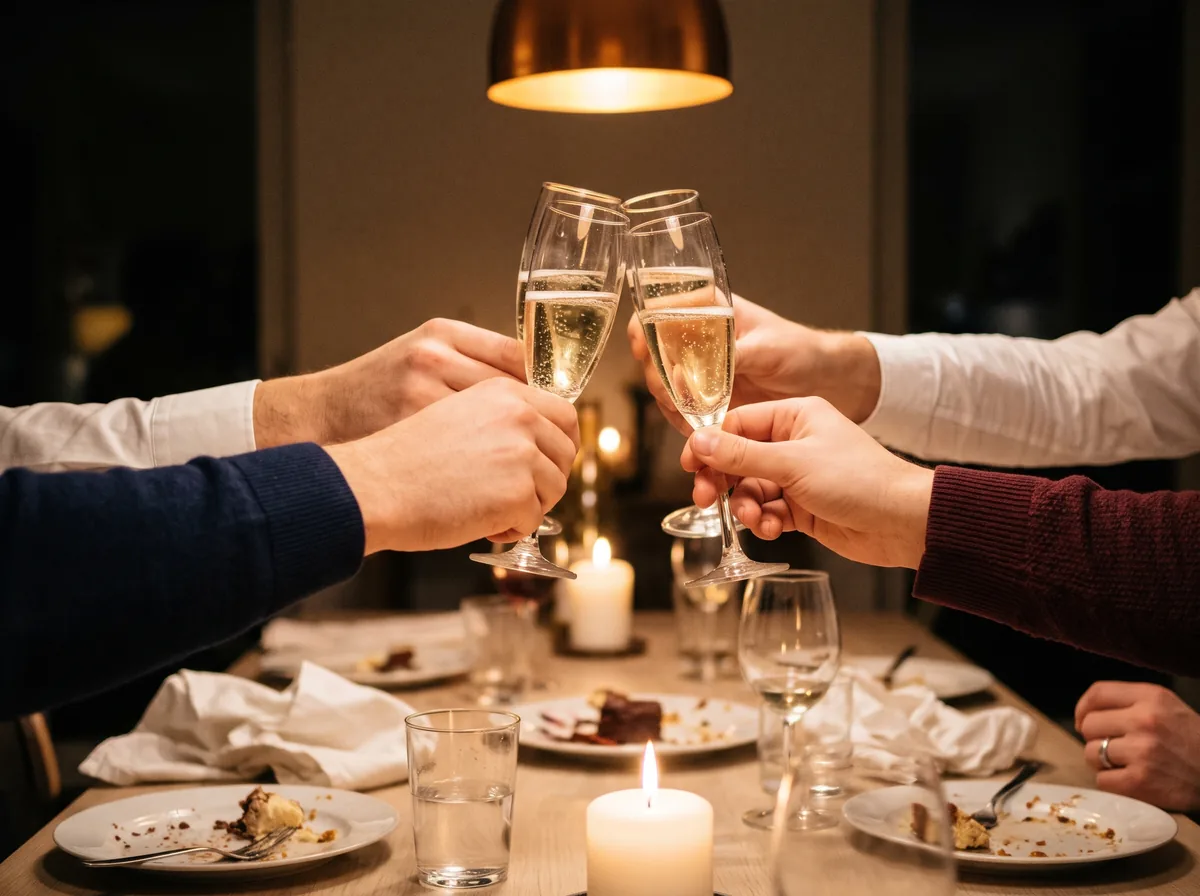
- A cava toast at dessert. If the menu doesn’t include it, ask the price of a few bottles for the toast. It’s often better value than another course.
- Ten minutes standing for a welcome drink. A vermouth or a glass at the bar while everyone arrives saves half the group from waiting at the table next to an empty chair.
- If there’s budget left, spend it on the wine, not another dish. A better wine shows more than a fourth starter that gets left half-eaten.
On the night
- Arrive 30 to 45 minutes early with the photo of the table setting on your phone and compare: glasses, cutlery, napkins, tables.
- Put out the name cards yourself; don’t leave it to a busy restaurant.
- Have one contact at the restaurant and introduce yourself. Every question that night goes through you and them.
- Go over the allergies with whoever is serving: each person’s name and seat.
- If management is speaking, keep it short, and between the main and dessert, when everyone is seated and nobody has got up yet.
- Check the bill before you pay: number of menus, extra drinks, coffees and the deposit already paid.
What surprised us in the menus
Lunch isn’t cheaper than dinner. None of the fourteen publishes a lower lunchtime price. Choosing lunch helps you find a table, not save money.
December costs more, and one place says so. El Ceibo warns that its menus cost €2 more per person in December “because raw materials go up”. Elsewhere the rise is built into the Christmas menu: at 7 Portes, year-round group menus start at €52 and the Christmas one at €72.
Wine is measured the same almost everywhere: one bottle per three people. Tracatrá gives half a bottle each and Robata one per two.
And at Santa Anna
We don’t do a special Christmas menu. For groups we have our four year-round menus, from €22 to €43 a head including VAT: Tapeo, Paella, Santa Anna and Terramar, all with water and wine or sangria at one bottle or one litre per three people, and soft drinks €1 extra. Coffee isn’t on the menu. We join the tables into a long table in the dining room, the kitchen stays open through the afternoon and we’re thirty metres from La Rambla. Ask us the same questions you’d ask anywhere on this list. All four menus, dish by dish, are on our restaurant for groups in Barcelona, and if you’re still looking, our list of central restaurants for a company dinner has more options.
FAQ
How much does a company Christmas dinner cost in Barcelona in 2026? At the six restaurants that publish a company Christmas menu, the cheapest costs €47 to €72 a head, with a median of €60. Year-round group menus start below €30.
What should I ask the restaurant before booking? How each course is served, whether cutlery is changed between courses, how many glasses each person gets, what happens when the menu’s drinks run out, whether coffee is included, until what time the table is yours, the deposit and the deadline for final numbers.
Why ask for a photo of the table setting? It’s the only way to know before the night how the table will look: tablecloth, glasses, cutlery and how the tables are joined. On the night you arrive early and compare.
How do I make a budget menu feel more special? Ask for a cutlery change and two glasses each, cloth tablecloth and napkins, a plated main and one area for the group. Add name cards, a printed menu and a cava toast at dessert.
Is lunch cheaper than dinner? Not at the restaurants we read: none publishes a lower lunchtime price. There are usually more free tables at lunchtime, though.
How big is the deposit, and how far ahead are final numbers due? From a flat €50 to 50% of the total. Final numbers are due 48 hours to two days before, and mains 72 hours to four days before.
To book
Call us on +34 933 18 63 36 or email reservas@restaurantsantaanna.com with the number of people, the day and the menu. If there are only a few of you, you can book here and order from the menu. And if your plan is the night of the 24th, first read how Barcelona spends Christmas Eve.
Carrer de Santa Anna 8, thirty metres from La Rambla. Open every day.
Sun to Thu 11:00 – 23:30Fri and Sat 11:00 – 00:00